
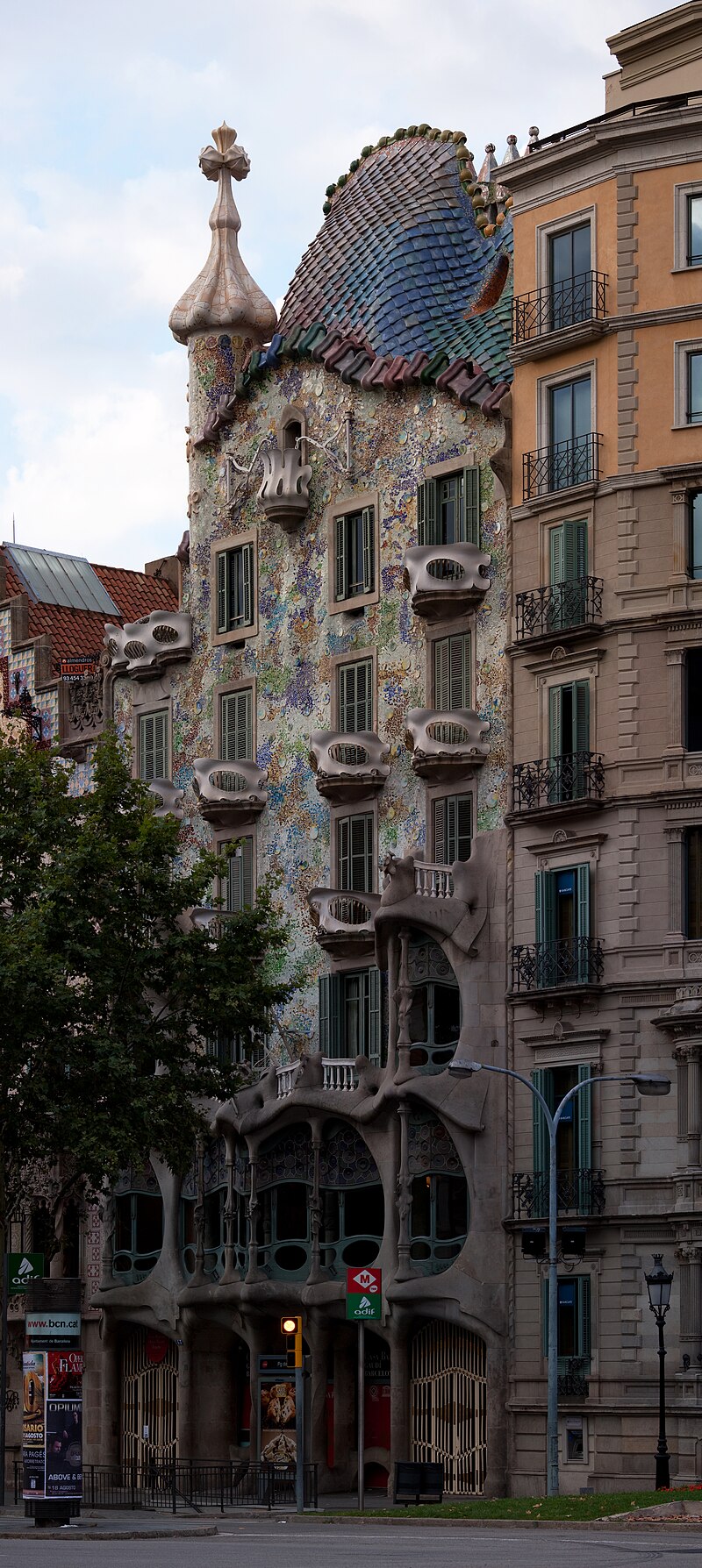
Walking along Passeig de Gracia, Barcelona's most elegant boulevard, you encounter two buildings that seem to belong to a world where stone flows like water and walls breathe like living organisms. Casa Batllo and Casa Mila, both designed by Antoni Gaudi and sitting just three blocks apart, represent the peak of the architect's creative powers and his ability to transform conventional residential buildings into works of art.
Casa Batllo: The House of Bones
In 1904, textile industrialist Josep Batllo i Casanovas commissioned Gaudi to renovate an existing apartment building at Passeig de Gracia 43. Rather than demolish and rebuild, Gaudi performed what might be the most creative renovation in architectural history, transforming a conventional mid-19th century structure into a building that appears to pulse with organic life.
The Facade
The facade of Casa Batllo is unlike anything else in architecture. The lower floors feature bone-shaped stone columns and skull-like balconies, earning the building its popular nickname "Casa dels Ossos" (House of Bones). Above, the surface is covered in a shimmering mosaic of ceramic discs in blues, greens, and mauves that shift color throughout the day, evoking the surface of the sea.
The crowning element is the roof, shaped like the scaled back of a dragon, complete with a cross-topped turret that some interpret as Saint George's lance piercing the beast. This interpretation connects to the legend of Sant Jordi (Saint George), the patron saint of Catalonia. The entire facade can be read as a retelling of this legend: the stone columns are the dragon's victims, the ceramic scales are its skin, and the cross is the lance that defeated it.
The Interior
Inside, Gaudi redesigned virtually everything. The main floor, the Batllo family's living quarters, features flowing rooms where walls curve and doors are shaped like leaves. A central light well, lined with tiles that grade from deep blue at the top to pale white at the bottom, distributes natural light evenly throughout the building. Even the furniture, designed by Gaudi specifically for the house, follows ergonomic curves derived from the human body.
The attic level features a series of catenary arches in white plaster, creating a space that resembles the ribcage of a large animal. The roof terrace, with its famous dragon-back ridge and colorful chimney pots, offers one of the best views of Passeig de Gracia.

Casa Mila (La Pedrera): The Stone Quarry
Three blocks up Passeig de Gracia, at the corner with Carrer de Provenca, stands Casa Mila. Commissioned in 1906 by Pere Mila i Camps and his wife Roser Segimon, this was Gaudi's last major secular work before he devoted himself entirely to the Sagrada Familia.
A Revolutionary Structure
Casa Mila was revolutionary in both form and engineering. The building has no load-bearing walls. Instead, it rests on a skeleton of stone columns and steel beams, a technique that allows the facade to undulate freely, like waves frozen in limestone. This structural innovation, combined with an underground parking garage (one of Barcelona's first), made Casa Mila an engineering marvel ahead of its time.
The nickname "La Pedrera" (The Stone Quarry) was originally a mocking comment from Barcelonians who found the rough, undecorated limestone facade ugly and out of place on their most fashionable street. Today, the name has become affectionate rather than derisive, and the building is recognized as one of Gaudi's finest achievements.
The Roof Terrace
The rooftop of Casa Mila is perhaps its most photographed feature. A surreal landscape of ventilation shafts and chimney stacks, sculpted into warrior-like figures with helmeted heads, rises above the undulating floor surface. Some chimneys are covered in trencadis mosaics, while others feature a rougher, more sculptural finish. The terrace provides spectacular views of Barcelona, including a direct sightline to the Sagrada Familia.
The Espai Gaudi
The attic of Casa Mila, now called "Espai Gaudi," is a museum dedicated to explaining Gaudi's design principles. The space is defined by 270 catenary arches in exposed brick, creating an interior that has been compared to the belly of a whale. Models, plans, and interactive displays illustrate how Gaudi drew from nature, geometry, and his Catholic faith to develop his unique architectural language.
The Block of Discord
Casa Batllo sits on the so-called "Manzana de la Discordia" (Block of Discord), a single block of Passeig de Gracia where three of Catalonia's greatest Modernisme architects each contributed a building. Alongside Gaudi's Casa Batllo, you will find Josep Puig i Cadafalch's Casa Amatller (with its stepped Dutch-style gable) and Lluis Domenech i Montaner's Casa Lleo Morera (with its ornate sculptures and stained glass). The "discord" refers to the striking contrast between their styles, though all three belong to the same Modernisme movement. Visiting all three provides an excellent introduction to the diversity within Catalan Art Nouveau.
Visiting Tips
- Both buildings are on Passeig de Gracia, easily reached by metro (L2/L3/L4, Passeig de Gracia station)
- Casa Batllo offers daytime and evening visits; the nighttime experience includes a rooftop light show in summer
- Casa Mila's night visits include a rooftop projection show called "La Pedrera by Night"
- Book tickets online in advance through the Casa Batllo and La Pedrera official websites
- Walking between the two buildings takes about 10 minutes, making it easy to visit both in a single outing
- The Passeig de Gracia area has many cafes and restaurants ideal for a break between visits

